
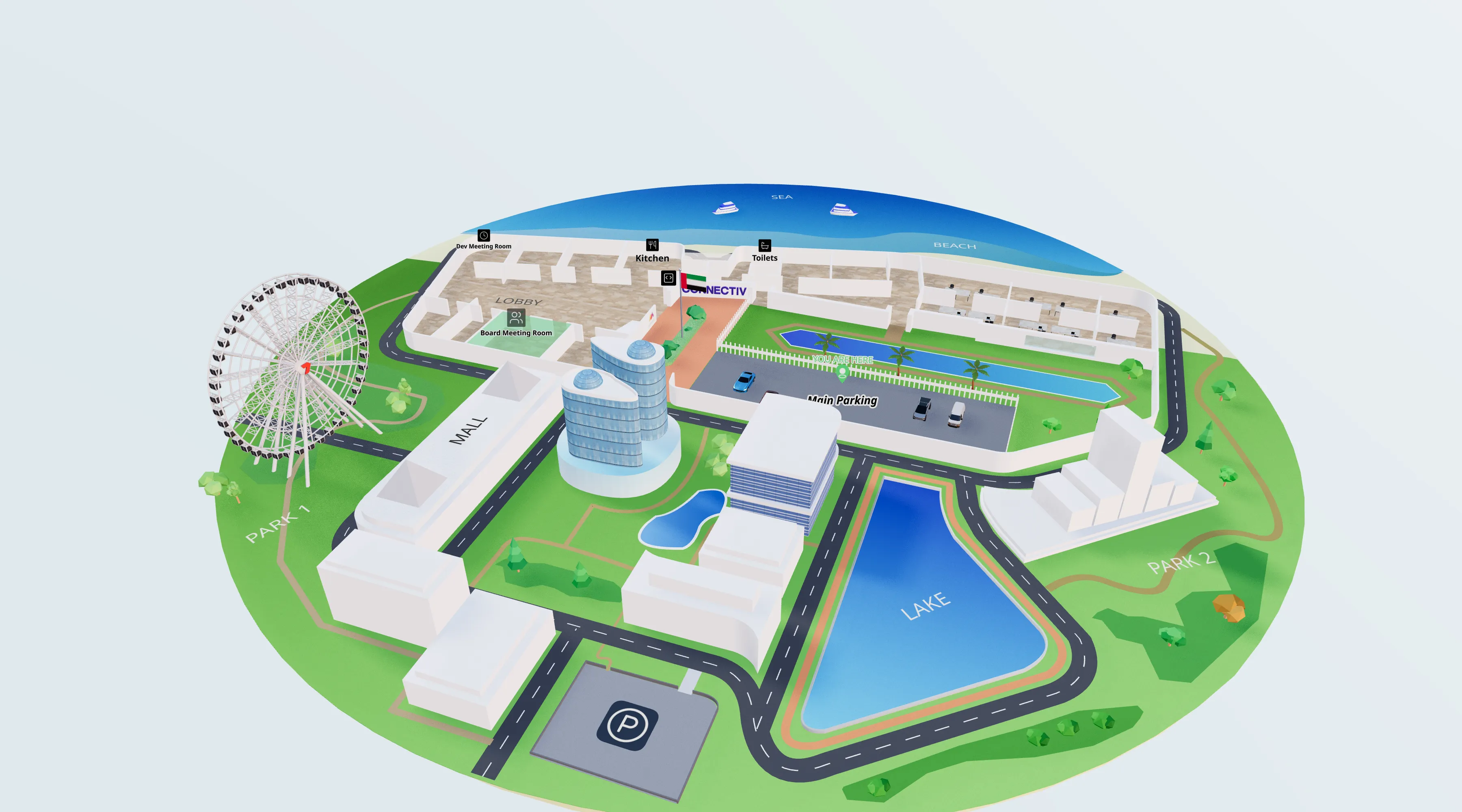
Mall wayfinding that gets shoppers to the store
Shoppers find the store, the tenant gets the footfall, and your information desk stops being a directions desk.
Higher foot traffic
Make shops stand out. Push customised discounts and recommendations to reach a wider audience and increase sales.
Lease optimisation
Maximise the potential of your mall's spaces. Collect and analyse data to make informed decisions about leasing and tenant placement.
Navigation people enjoy
Turn point A to point B navigation into something shoppers actually use. Safer evacuations and step-free routes where they are needed.
Who gets lost, and what it costs
Shoppers looking for one specific store, a toilet, the car park level they came in on, or the entrance nearest their car. Most of them will never ask anyone. They walk, they guess, and if it takes too long they leave without buying the thing they came for.
- Upper floors and far wings under-perform
- Tenants away from the main circulation route complain that footfall is not reaching them, and they raise it at every lease renewal.
- The information desk becomes a directions desk
- Staff hired to handle complaints, lost property and gift cards spend the day pointing at a printed board.
- Abandoned trips
- A shopper who cannot find a store within a few minutes does not usually keep looking. That is a sale the tenant never knows it lost.
- Car parks at closing time
- People who cannot remember which level or which entrance they used turn the end of the day into a support problem.
Deployed at
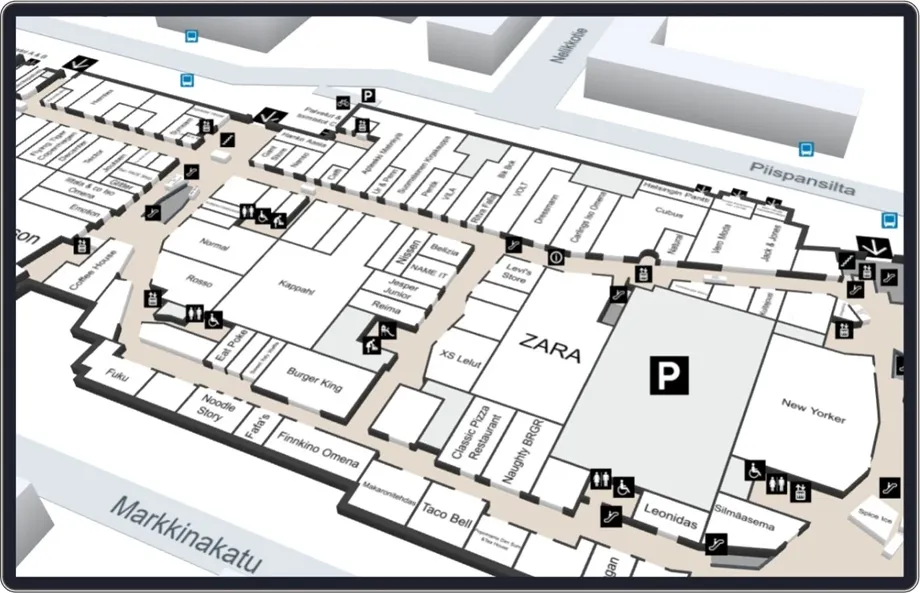
Iso Omena
Our clients in the private property sector are pleased with the aesthetic of the map, guiding quickly and successfully the user whilst keeping an eye-catching 3D look.
- 20M+
- Annual visitors
- 200+
- Retail stores
What changes
- Search by what people call it, not what the lease calls it
- Someone typing "phone shop" reaches the electronics tenant. Someone typing a brand reaches the unit. Someone typing in Arabic reaches the same place.
- A route with the right escalator
- From where the shopper is standing to the unit door, across levels, with walking time. Not a highlighted rectangle on a plan.
- Kiosk to phone, with no app
- A shopper scans the code at an entrance kiosk and the live route transfers to their phone, so they are not memorising turns.
- A tenant move is a content edit
- Change it once and every kiosk, the website and the app update together. No reprint, no signage contractor, no wait.
Tools for modern malls
Unique 3D models
A library of ready-to-use 3D models, so your mall map looks like your mall and not like a template.
Multi-device publish
Publish to kiosks, web and mobile apps for iOS and Android at the same time.
Powerful import and export
Works with .dwg, .pdf and GeoJSON. Skip the redraw and get to map creation.
Access control
Different permissions by profile type, so back-office information stays in the back office.
CMS integration
Connect your existing CMS, or use the built-in one to manage store and POI information.
Common questions
- How do shoppers find the map without downloading an app?
- Three ways, and most malls use all of them. A QR code on existing signage and on kiosks opens the map in the phone browser. The mall website embeds the same map. If you already have an app, Mapwise runs inside it. Nothing needs installing.
- What happens when a tenant moves or a unit changes hands?
- Somebody on your team edits the destination in the CMS and every surface updates at once: kiosks, web and mobile. That is the difference between a map and a printed board, and it is the thing that decides whether the system is still accurate in two years.
- Can we promote tenants or offers inside the map?
- The platform supports categorised, searchable destination content with images and descriptions, which is what makes a store discoverable. Talk to us about the specific promotional placement you have in mind and we will tell you plainly what is available today rather than what is on a roadmap.
- Does it work in Arabic as well as English?
- Yes. Predictive search matches in both languages, including the spelling variants people genuinely type, and the interface mirrors properly for right-to-left rather than sitting inside a left-to-right layout. Labels stay legible when the map is tilted into 3D, which is where most bilingual maps quietly fail.
Read next
2D and 3D indoor maps
When three dimensions help a visitor, when they get in the way, and how to offer both.
How indoor wayfinding works
What a wayfinding system contains, what it replaces, what it costs, and when it is not worth doing.
Indoor wayfinding in the UAE
Bilingual maps for Emirates venues, delivered from our Dubai innovation centre.
Ready to digitalise your mall?
Send us one floor plan. We will build a working map of your space and walk you through it.