
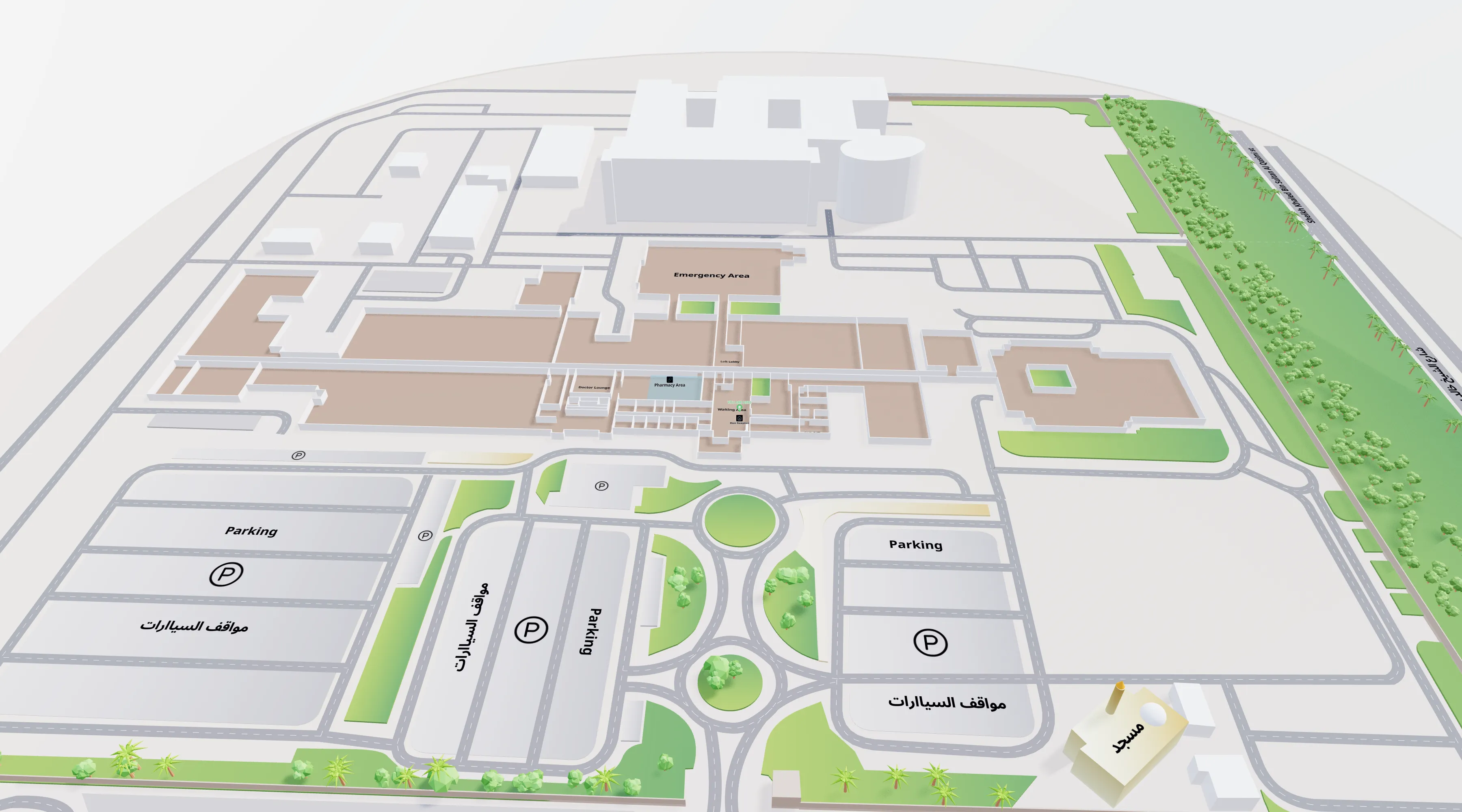
Hospital wayfinding that gets patients to the right clinic
Patients search by department, clinic or the wording on their appointment letter, then follow a route from the right car park to the right door.
Accessible for everyone
Adapted routing for all patients. Waiting areas, labs and doctors' rooms are easy to find, in line with accessibility standards.
Operational efficiency
Better inventory management and lower costs, with real-time tracking of assets like wheelchairs, beds and medical equipment.
Safety and security
Respond to incidents in real time and help people reach the nearest safe place during an emergency.
Who gets lost, and what it costs
First-time outpatients, elderly visitors, relatives, and delivery staff. Usually anxious, often already late, and almost always in a building that has been extended three or four times, where the department named on the appointment letter is not the name on the door.
- Around 30% of first-time visitors get lost
- In large hospitals. Most of them will ask a member of staff rather than work it out, and most of that staff time is unrecorded.
- 4,500 staff hours a year at one medical centre
- Spent giving directions. That is a full-time role, funded out of clinical and reception budgets that were never meant to carry it.
- Late arrivals cascade
- One patient arriving ten minutes late does not stay a ten-minute problem. It moves the whole list, and that is the number a hospital finance director actually feels.
- Signage cannot keep up with the estate
- Departments move, wings are rebuilt, and the wayfinding signs are updated last because every change is a physical job.
Deployed at
Stamford Hospital
Mapwise is for us a great partner to collaborate and grow with.
- 140km²
- Mapped area
- 305
- Beds
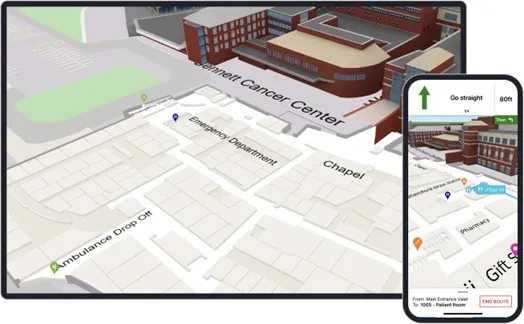
What changes
- Search by the words on the appointment letter
- Department, clinic, or consultant name. The letter says "Ambulatory Care" and the sign says "Zone C", so the map has to know both.
- The right car park to the right door
- Routing that starts outside, crosses between buildings and levels, and ends at the clinic reception rather than at the building entrance.
- Step-free routing
- A separate route for anyone who cannot use stairs or escalators, so accessibility is a mode rather than a note at the bottom of a page.
- A link in the appointment letter or SMS
- That opens the map at the correct destination, before the patient has left home. This is the single change that removes the most anxiety.
Try a real hospitals and healthcare map
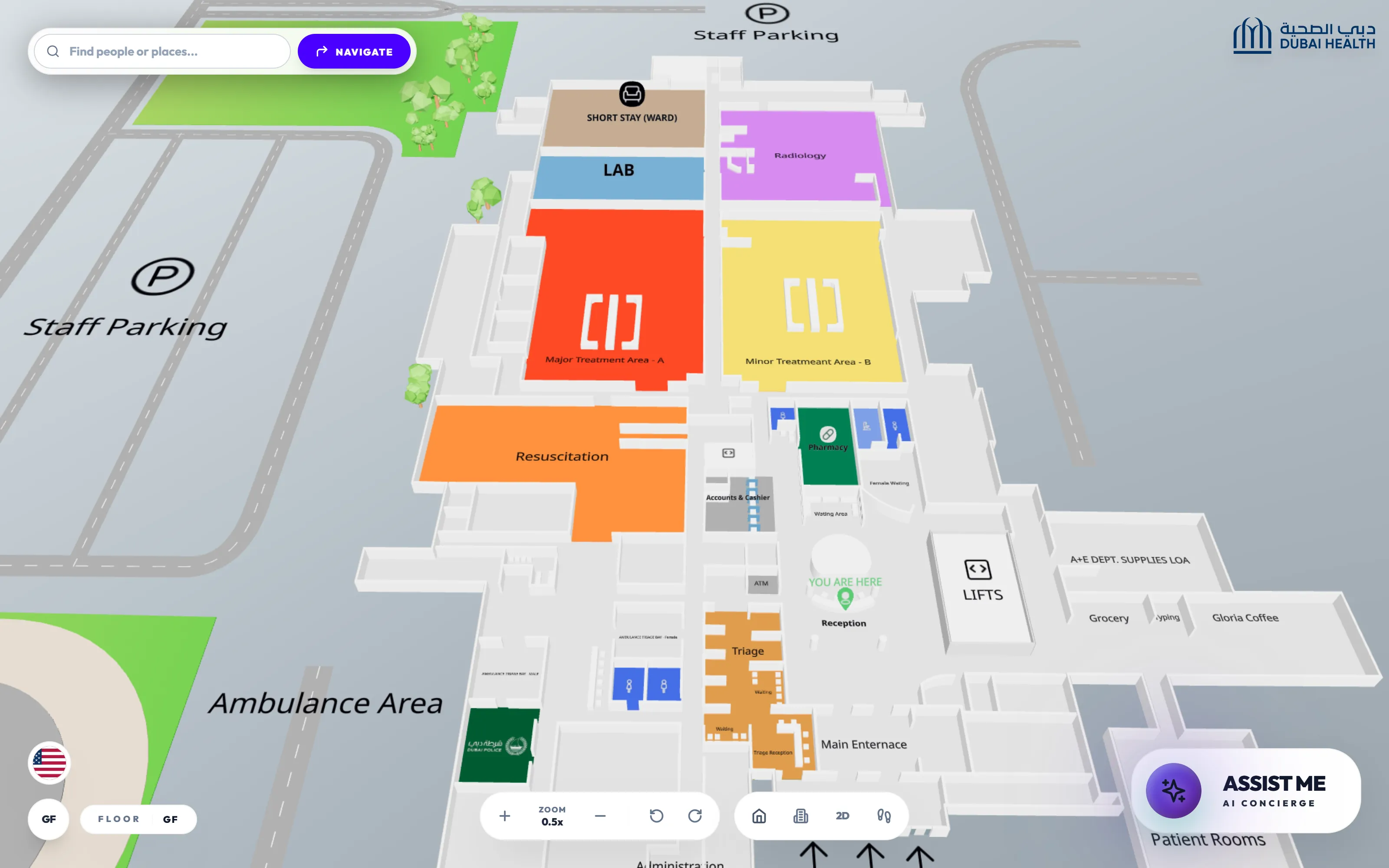
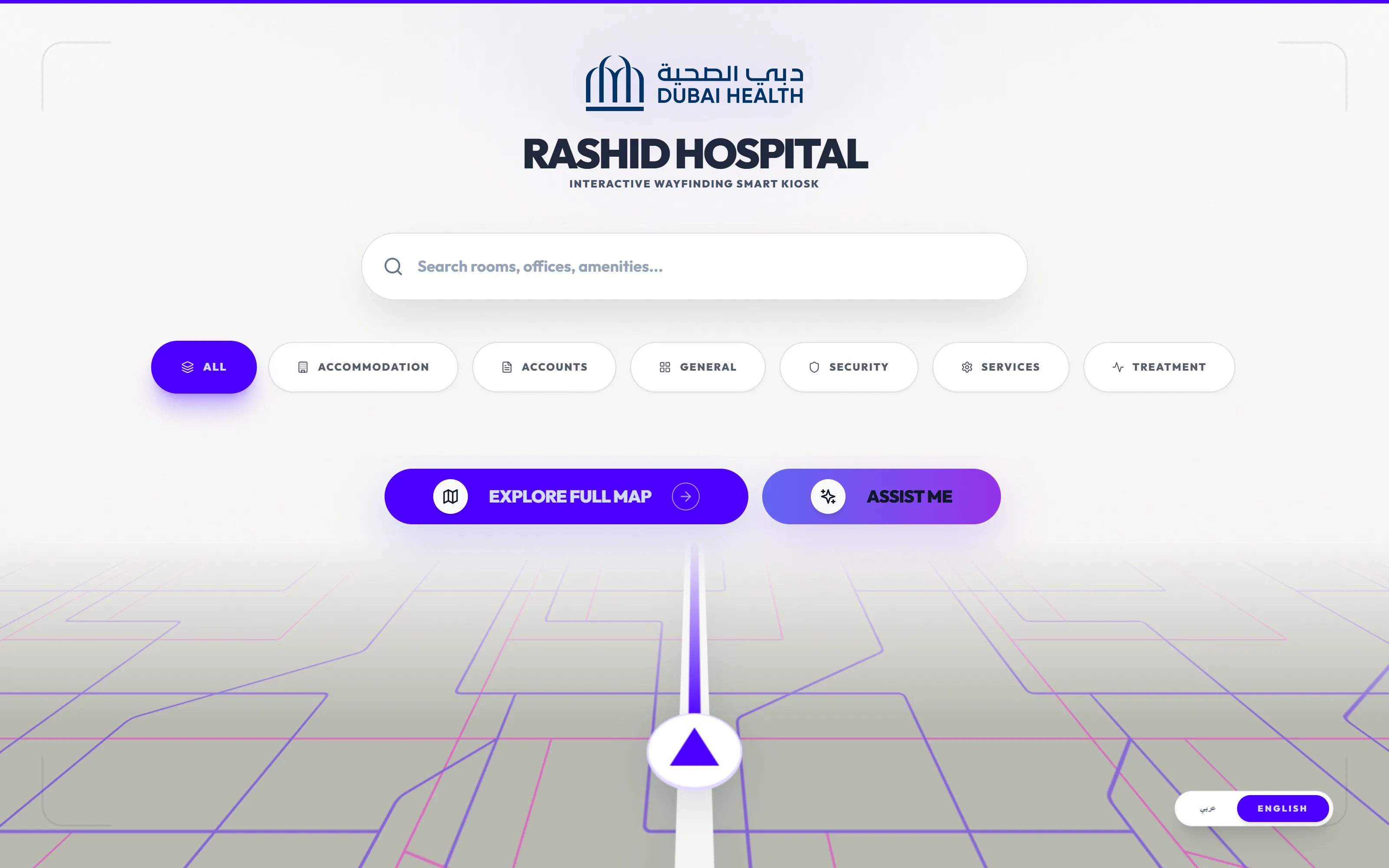
The emergency department at Rashid Hospital, mapped for Dubai Health and running as a bilingual smart kiosk. Departments are colour-coded, and the map opens on the branded home screen the hospital runs on the floor.
Loads the live map. Search, route, and switch between 2D and 3D.
Tools for medical facilities
Draw like a pro
Build hospital maps from scratch using simple geometric shapes to define a complex facility layout.
3D medical assets
Every project includes a library of ready-to-use 3D models, so the map reads clearly to an anxious visitor.
Multi-device publish
Kiosks, web and mobile apps for iOS and Android, published together.
Access control
Manage sensitive areas with separate authorisations for staff, patients and visitors.
Easy import and export
Support for .dwg, .pdf, images and GeoJSON, so your existing architectural plans go straight in.
CMS integration
Connect your existing content management system, or use the native one to manage doctor and department locations.
Common questions
- Does the map track patients?
- No. Mapwise shows the building and calculates routes through it. It is not a people-tracking system, and it does not need to know who is holding the phone in order to give directions. This question arrives early in every healthcare conversation and that is the honest answer.
- Where is the data hosted?
- Confirmed per project. If in-region hosting is a procurement requirement for your trust or authority, raise it in the first call and we will tell you what is available before you invest time in an evaluation.
- Can we route people who cannot use stairs?
- Yes, step-free routing is a separate mode rather than the same route with a warning attached. Set it once and the map avoids stairs and escalators for that journey.
- Our estate changes constantly. Who keeps the map current?
- You do, through the CMS, and that is deliberate. A map that needs a support ticket for every department move goes stale, and a stale hospital map is worse than no map because people stop trusting it. Whoever owns signage changes should own the map.
- We already have an app. Do patients need another one?
- No. Mapwise runs inside your existing iOS and Android app, and on the web for everyone else. A QR code on existing signage opens the same map with no install.
Read next
How indoor wayfinding works
What a wayfinding system contains, what it replaces, what it costs, and when it is not worth doing.
Choosing indoor wayfinding software
The eight criteria that matter when comparing platforms, and the questions vendors avoid.
Indoor wayfinding in Saudi Arabia
Arabic-first wayfinding for malls, hospitals, airports and campuses across the Kingdom.
Ready to upgrade your facility?
Send us one floor plan. We will build a working map of your space and walk you through it.