
Built for buildings that visitors see once
The UAE has an unusually high concentration of the buildings indoor wayfinding exists for: very large malls, major international airports, sprawling resort properties, multi-building hospital campuses and mixed-use developments. Most of them are visited by people who have never been there before and will not come back for a year.
That is the exact case where signage struggles. A sign assumes you already know roughly where you are going. A searchable map does not.
Arabic and English as equals
In a market where both languages are in daily use, "we support Arabic" is not a useful answer. What matters is whether it works under pressure:
- Search that matches how people type
- Spelling variants people genuinely use, not just the official transliteration.
- Route instructions that read right to left
- Directions mirror properly rather than sitting inside a left-to-right layout.
- Kiosks that switch cleanly
- Language changes between one visitor and the next without the layout breaking.
- Labels that hold in 3D
- Text stays legible on a tilted map, which is where most bilingual maps quietly fail.
Ask any vendor you are evaluating to demonstrate all four in Arabic. It is a fair test and it narrows a shortlist quickly.
Bilingual maps, running in the Emirates
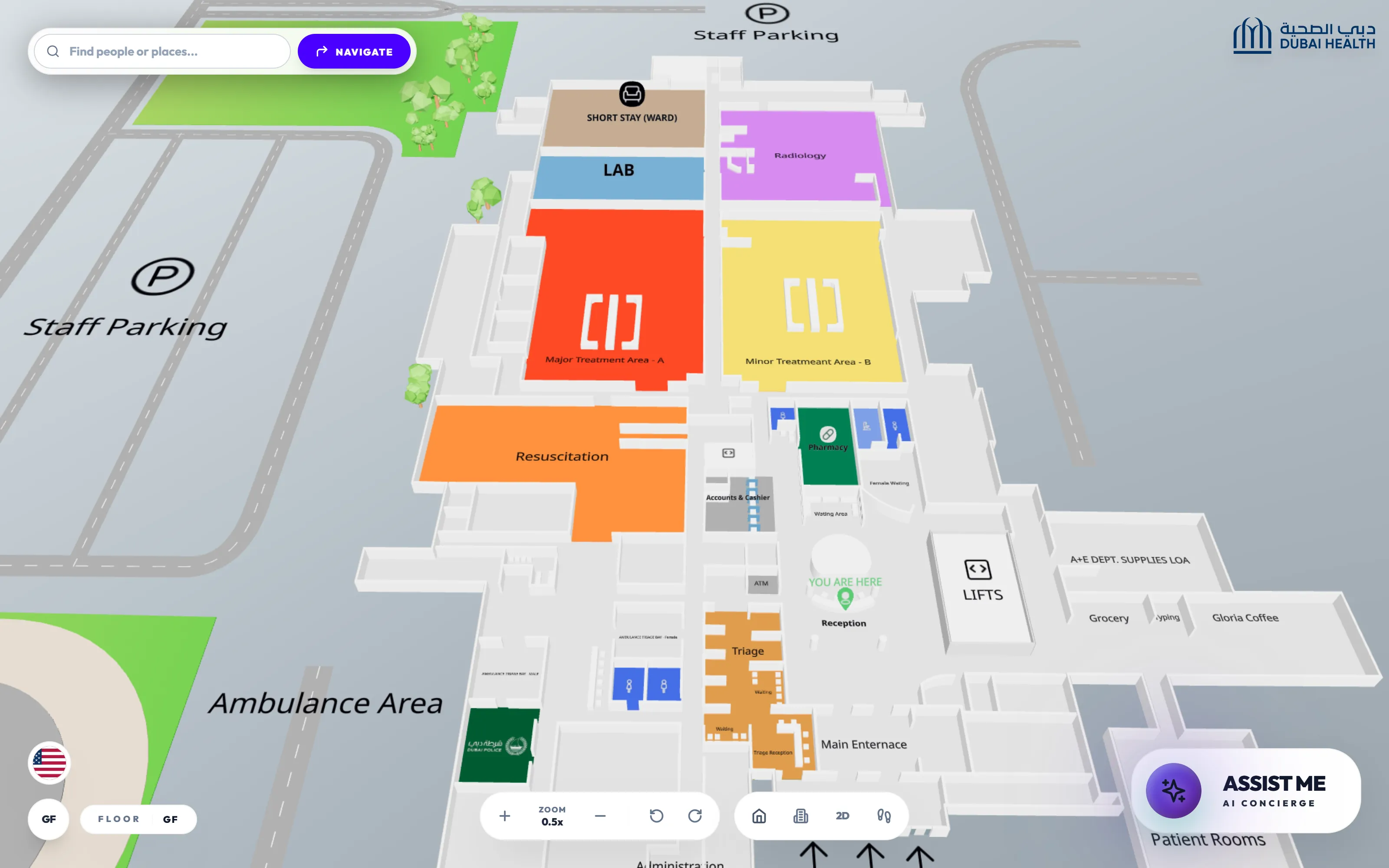
Three live examples, all of them real customer maps rather than demo venues. Start with Rashid Hospital, mapped for Dubai Health. This is the accident and emergency floor, colour-coded by department, and it opens on the branded kiosk screen that runs on the floor: search, category filters, and a switch between English and Arabic.
Loads the live map. Search, route, and switch between 2D and 3D.
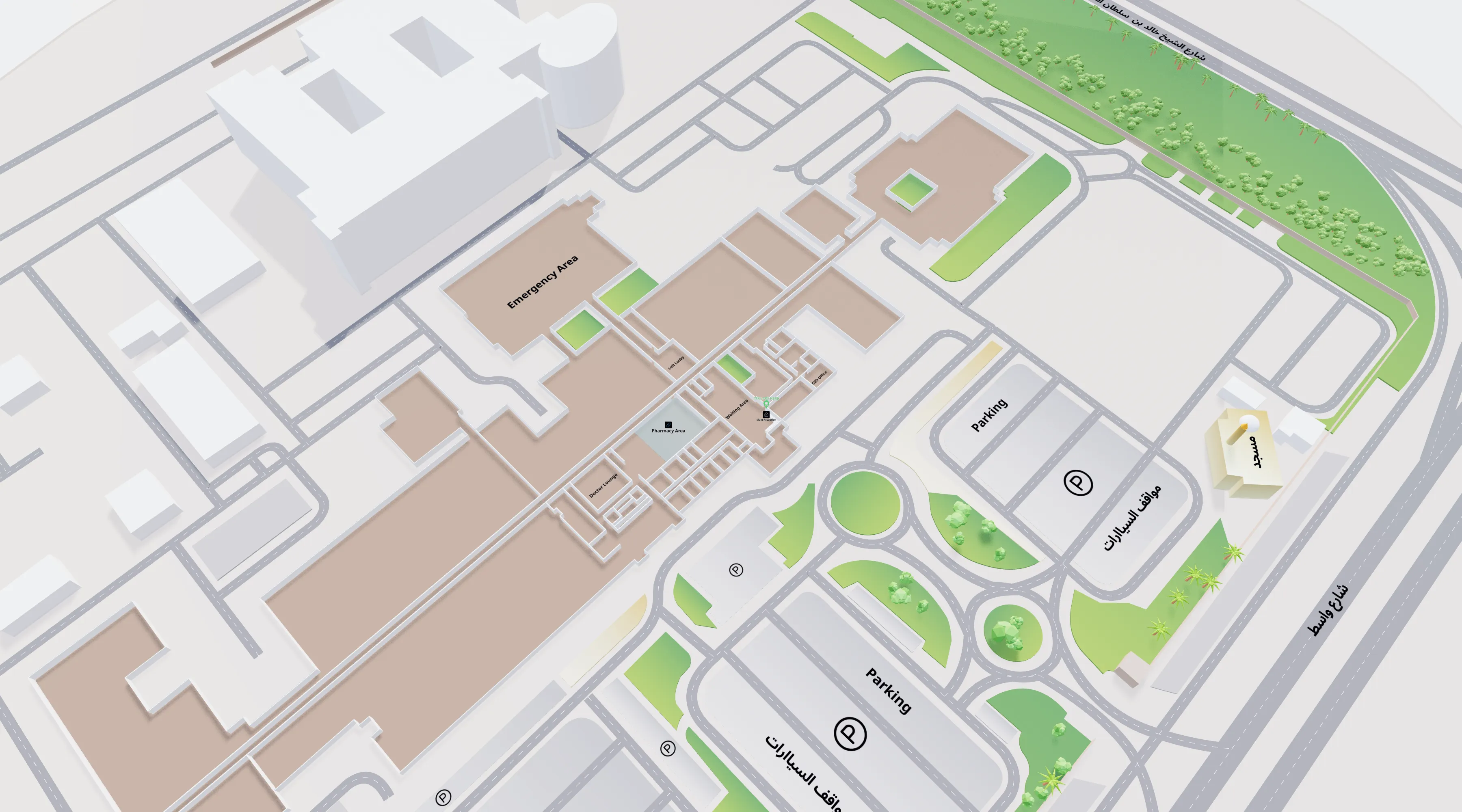
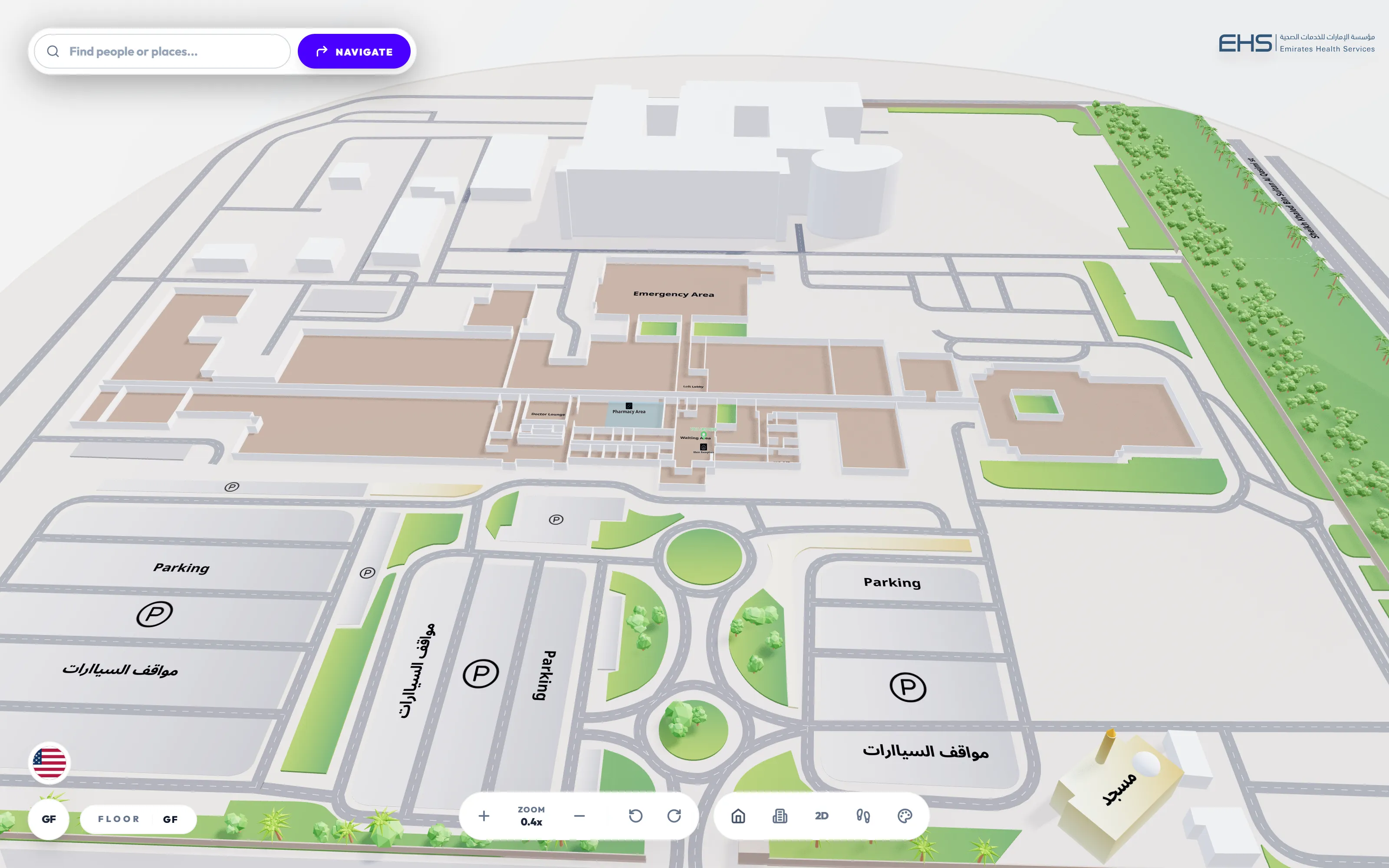
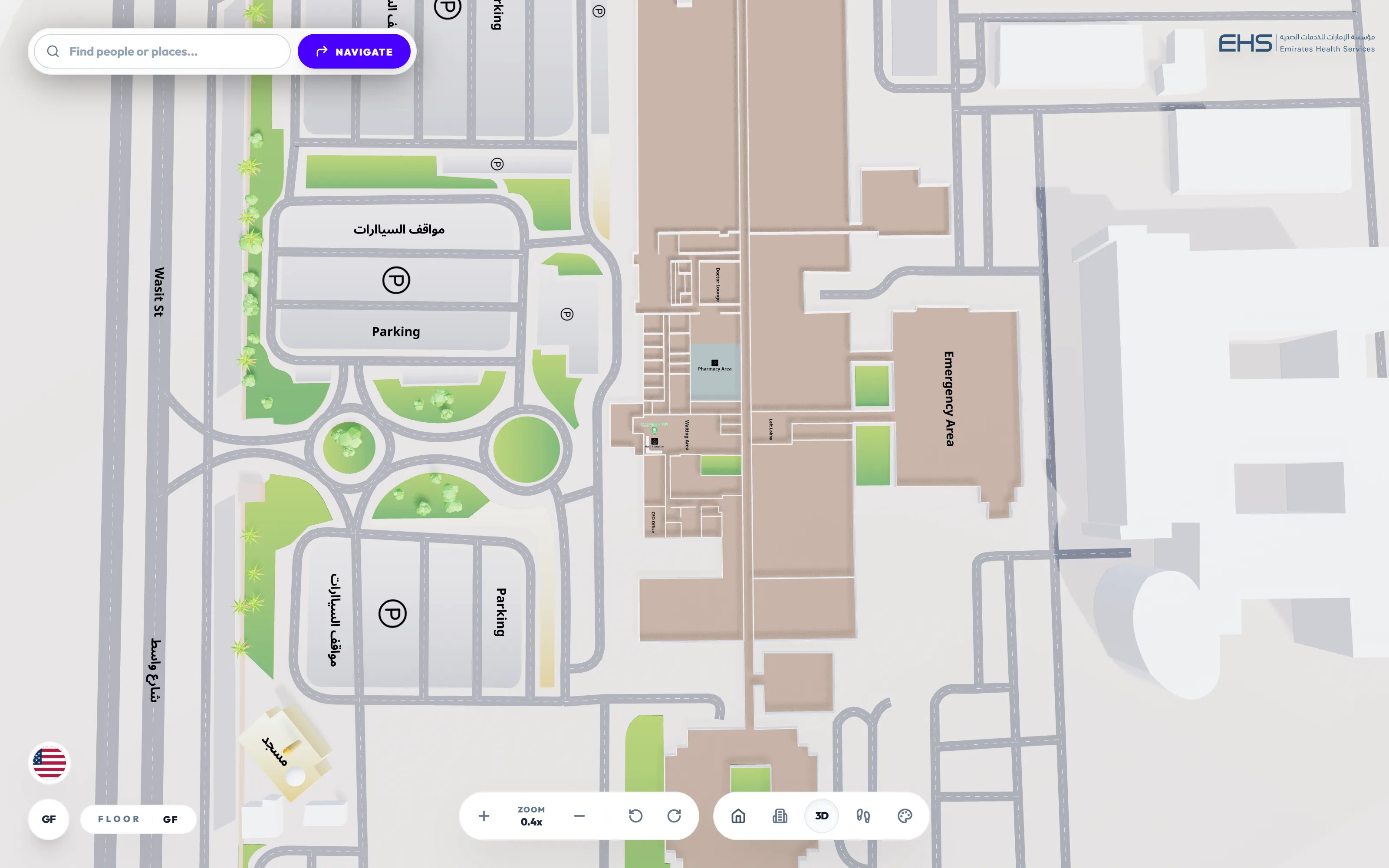
Al Qasimi Hospital, mapped for Emirates Health Services, renders English and Arabic labels side by side directly in the map rather than as an interface overlay. Switch between the views to see the same labelling hold in both.
 Design in progress
Same map, same points of interest.
KEZAD Group, the industrial and economic zone in Abu Dhabi, shows the same map carrying the venue's own brand, with Arabic street naming rendered into the 3D scene.
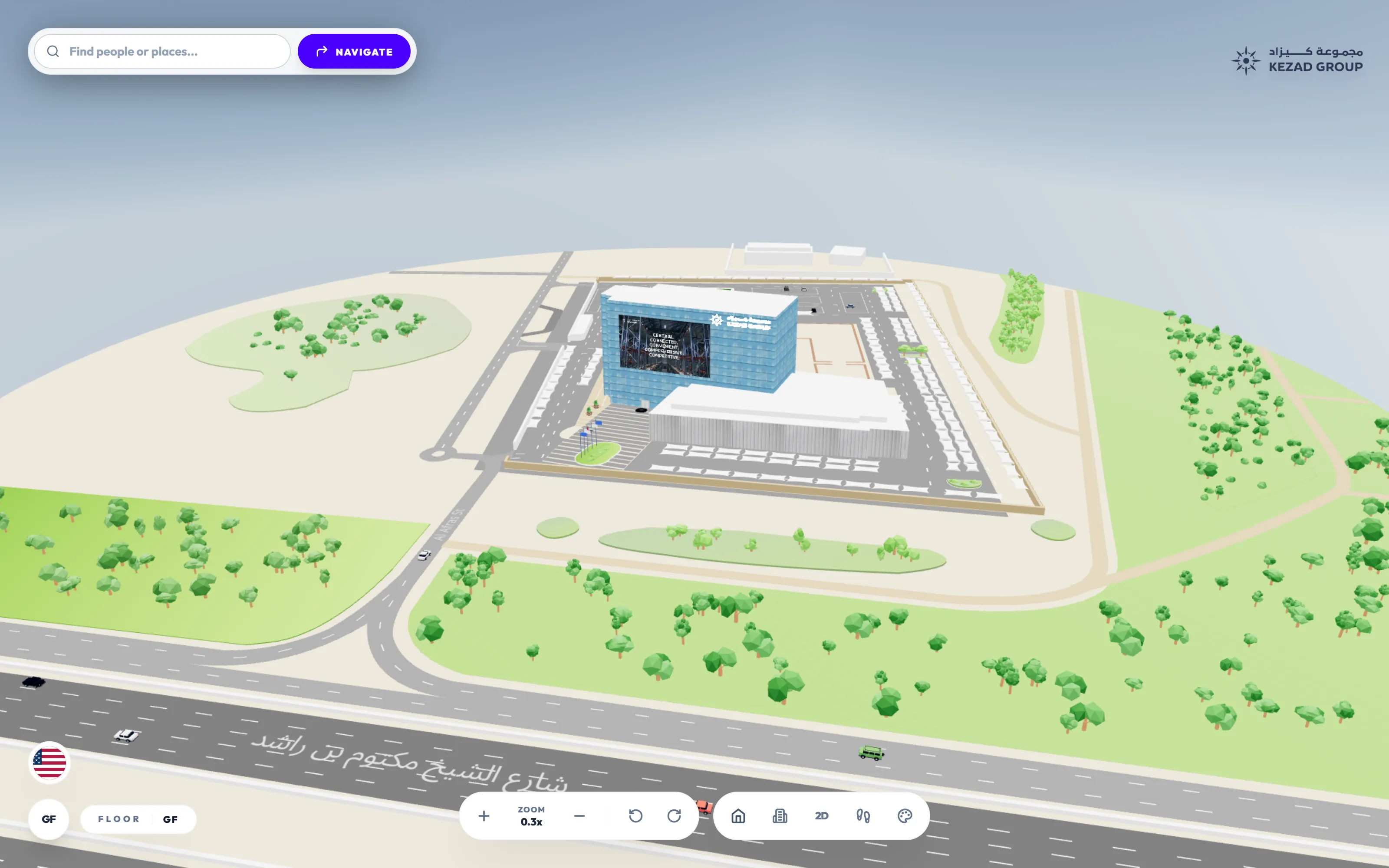
Loads the live map. Search, route, and switch between 2D and 3D.
Where it fits
- Malls and retail
- Multi-level centres with open atriums, where the level above and across the void is almost impossible to convey in a flat plan. Tenant changes become a content edit.
- Airports and aviation
- Mapwise covers two million square metres at Hamad International, guiding over 30 million passengers a year from check-in to boarding.
- Hotels and resorts
- Large properties with multiple buildings, restaurants, pools and event spaces. Conference floor plans can be reconfigured per event instead of reprinting boards.
- Hospitals
- First-time outpatients navigating a campus that has been extended several times, often with step-free requirements.
- Corporate and mixed-use
- Visitors reaching a meeting room without an escort, and staff finding facilities in buildings they attend part of the week.
Why a regional partner matters
The global platforms in this category are built and supported from North America and Western Europe. In practice that means deployment questions waiting on a timezone, Arabic handled as a localisation ticket, and reference customers your board has never heard of.
Indoor wayfinding in Dubai
Our innovation centre is in Dubai. Customers come in and see Mapwise on kiosk, phone and web at the same time, on their own floor plans rather than a demo venue. That is a twenty-minute meeting that replaces three weeks of slide decks, and it is the main practical reason to work with a team in the same city rather than the same category.
If your procurement requires in-region data hosting, raise it in the first call and we will confirm what is available before you commit time to an evaluation.
Getting started
Send one floor plan. We will build a working map of that space and walk you through it, in both languages, before you commit to anything. Starting with a single building or even a single floor is usually the fastest way to prove the workflow and find out who internally will own keeping it current.
If you are comparing vendors, read how to choose indoor wayfinding software. If you are earlier than that, indoor wayfinding explained covers the fundamentals. Also see indoor wayfinding in Saudi Arabia, the full platform, or the team behind Mapwise.