
Arabic that was designed in, not translated on
Most indoor mapping platforms treat Arabic as a language pack. That works until you need a route instruction to read right to left, a search that matches how people actually spell a place, or a label that stays legible on a 3D map viewed at an angle.
- Predictive search in both languages
- A visitor types in Arabic or English and reaches the same destination, with images and descriptions attached rather than just a pin.
- Native right-to-left interfaces
- Directions, listings and controls mirror properly instead of sitting awkwardly inside a left-to-right layout.
- Labels that survive 3D
- Text and icons rotate to face the camera at any viewing angle. Arabic letterforms connect, so distortion degrades legibility faster than it does in Latin script.
- Bilingual kiosks
- Switching language at an information point mirrors the layout rather than breaking it.
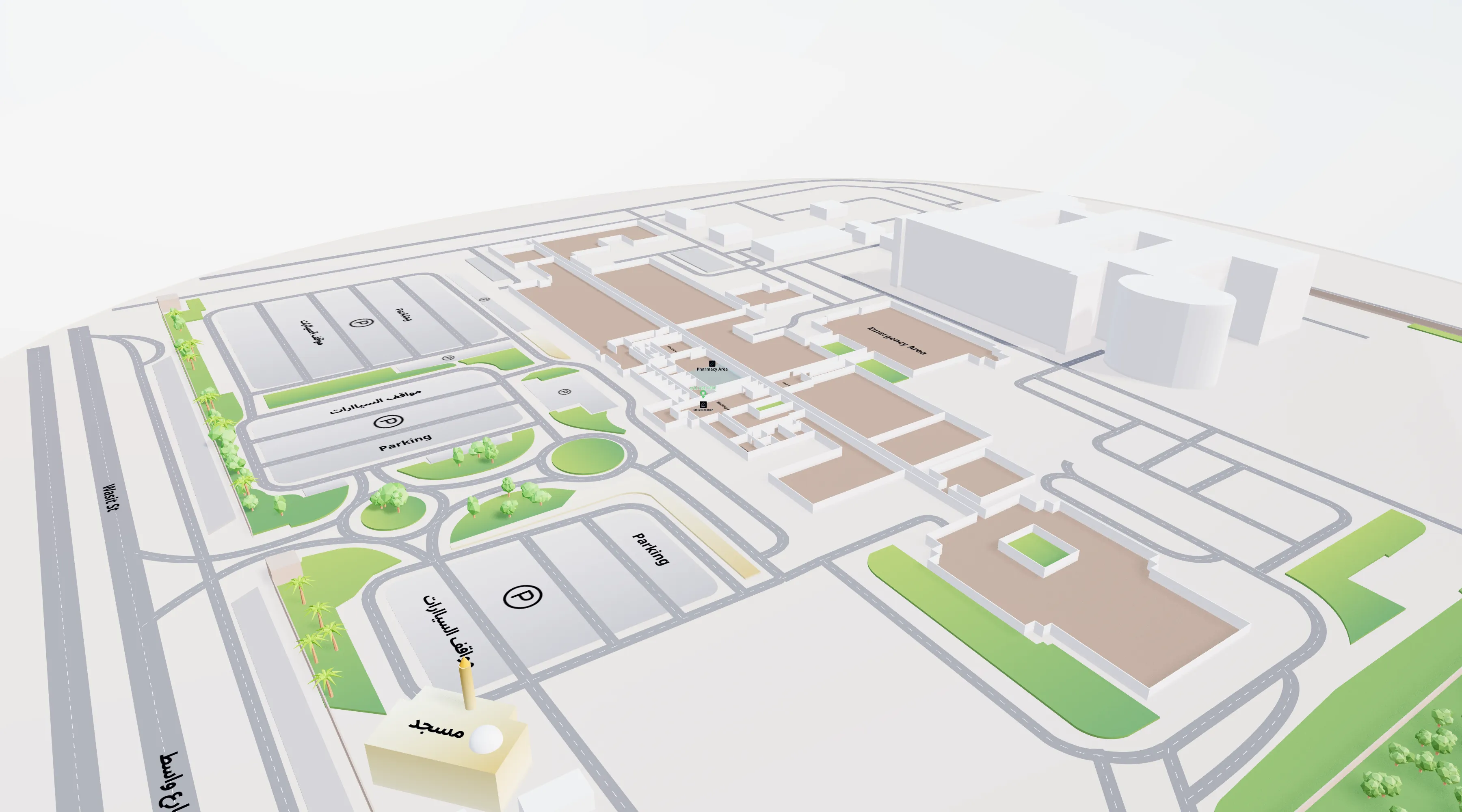
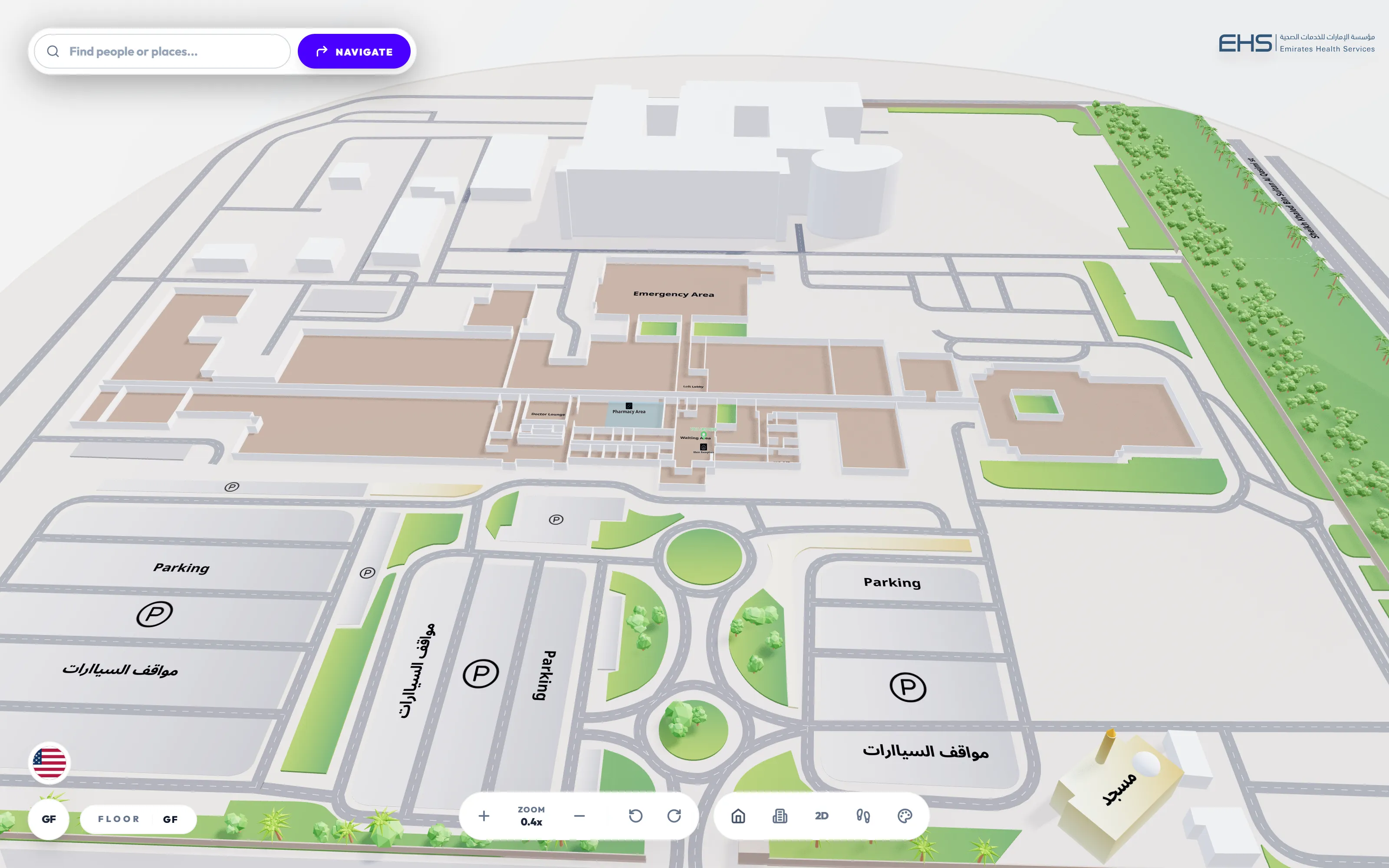
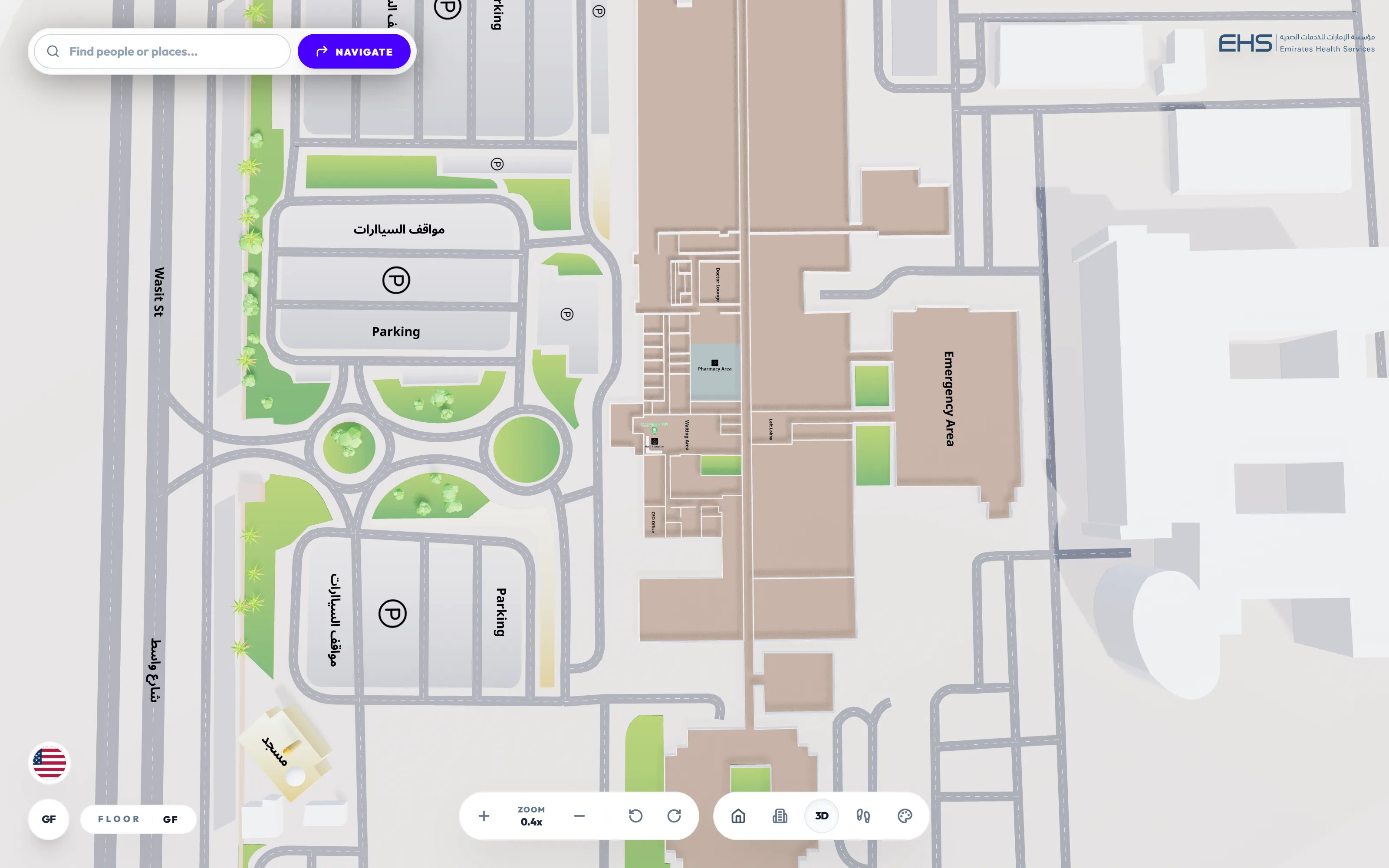
Below is Al Qasimi Hospital, mapped for Emirates Health Services. English and Arabic labels are rendered into the map itself rather than sitting in an interface layer, so they hold in both views.
 Design in progress
Same map, same points of interest.
Where this matters in the Kingdom
The venues where a visitor arrives once, needs one specific place, and has no mental model of the building.
Shopping malls
Large multi-level centres with frequent tenant changes. Shoppers search for a store by the name they know it by, in either language, and get a route with the right escalator.
Hospitals and healthcare
First appointments, often with a referral letter naming a department in one language and signage in another. Routing runs from the correct car park to the correct clinic, with a step-free mode.
Airports
We know this one. Mapwise covers two million square metres at Hamad International, guiding travellers from check-in to boarding while routing them past retail.
Universities and campuses
Multi-building sites where week one of term produces thousands of lost people at once. Routes cross between buildings and between indoor and outdoor space.
Government and public buildings
Where bilingual service and accessibility are procurement requirements rather than preferences, and the visitor may only ever come once.
What deployment looks like
Five steps, and the third one usually takes longest. Writing the destination content is the part venues underestimate.
Send us floor plans
DWG, PDF, GeoJSON or images. Whatever your architect produced.
We build the map
Rooms, corridors, stairs, lifts and the routes between them, in 2D and 3D from the same source.
You add content in both languages
Names, categories, opening hours, images and contact details, in Arabic and English.
Publish
Web, iOS, Android and kiosk at once, plus QR codes on existing signage.
Keep it current
A tenant moves, you edit once, and every surface updates.
Working with a regional partner
The global platforms in this category are built and supported from North America and Western Europe. That shows up in timezone gaps during deployment, in Arabic being a localisation ticket rather than a product decision, and in reference customers your stakeholders have never heard of.
Our innovation centre is in Dubai, where customers see Mapwise running on kiosk, phone and web side by side, on their own floor plans. If in-region data hosting is a procurement requirement, raise it early and we will confirm what is available before you invest time.
If you are comparing vendors, read how to choose indoor wayfinding software. If you are earlier than that, indoor wayfinding explained covers the fundamentals. Also see indoor wayfinding in the UAE, the full platform, or the team behind Mapwise.